

The full dataset viewer is not available (click to read why). Only showing a preview of the rows.
Error code: UnexpectedError
Need help to make the dataset viewer work? Make sure to review how to configure the dataset viewer, and open a discussion for direct support.
image
image |
|---|
OSMa-Bench Dataset
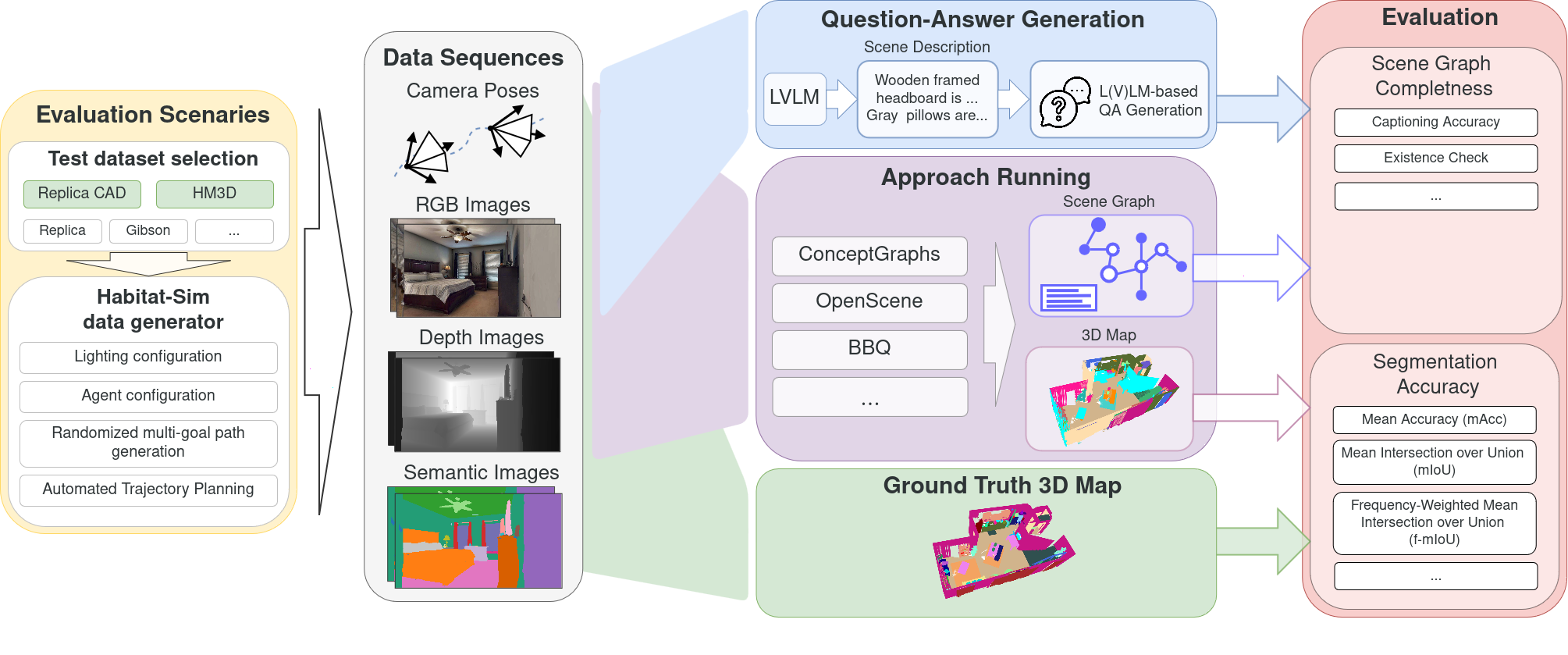
OSMa-Bench (Open Semantic Mapping Benchmark) dataset is a fully automatically generated dataset for evaluating the robustness of open semantic mapping and segmentation systems under varying indoor lighting conditions and robot movement dynamics. This dataset is part of OSMa-Bench pipeline.
- Homepage: OSMa-Bench Project Page
Dataset Summary
This dataset provides simulated RGB-D and semantically annotated posed sequences for evaluation of semantic mapping and segmentation, with a particular focus on handling dynamic lighting—a critical but often overlooked factor in existing benchmarks. It also includes a collection of automatically generated question–answer pairs across multiple categories to support the evaluation of scene-graph–based reasoning, offering a task-driven measure of how well a system’s reconstructed scene captures semantic relationships between objects.
The data is built upon two base datasets:
- ReplicaCAD: 22 scenes with 4 lighting configurations and a velocity modifier.
- Habitat Matterport 3D (HM3D): 8 scenes with 2 lighting configurations and a velocity modifier.
Installation
We offer two versions of the dataset: one with separate files and one as a single compressed archive. Use the following command to download the separated files (may be slow):
git xet install
git clone https://huggingface.co/datasets/warmhammer/OSMa-Bench_dataset -b main
and this command to download the compressed version (faster one):
git xet install
git clone https://huggingface.co/datasets/warmhammer/OSMa-Bench_dataset -b compressed
unzip data.zip
Data Configurations
The dataset includes the following configurations for the ReplicaCAD and HM3D scenes:
| Configuration | Description |
|---|---|
baseline |
Static, non-uniformly distributed light sources (ReplicaCAD only) |
dynamic_lighting |
Lighting conditions change along the robot's path (ReplicaCAD only) |
nominal_lights |
The mesh itself emits light without added light sources |
camera_light |
An extra directed light source is attached to the camera |
velocity |
Sequences recorded at doubled nominal velocity |
Data Configurations
The dataset provides structured data for each scene, suitable for tasks like 3D scene understanding, visual question answering, and robotics. Each scene contains the following components:
| Component | Description | Format / Example |
|---|---|---|
| RGB Images | Standard color images captured from different camera viewpoints. | frame000000.jpg, ... |
| Depth Images | Depth maps aligned with RGB images. Each pixel encodes depth in meters. | depth000000.png, ... |
| Semantic Masks | Pixel-wise semantic segmentation labels. Each pixel corresponds to a semantic class ID. | semantic000000.png, ... |
| Camera Trajectories | Flattened 4×4 transformation matrices representing camera poses for each frame. | traj.txt (one 4×4 matrix per line) |
| Question-Answer Pairs | Validated question-answer pairs related to the scene, optionally associated with specific frames. | validated_questions.json |
VQA Question Categories
The dataset includes a automatically generated answer-question pairs with the following question types:
Binary General – Yes/No questions about the presence of objects and general scene characteristics
Example:Is there a blue sofa?Binary Existence-Based – Yes/No questions designed to track false positives by querying non-existent objects
Example:Is there a piano?Binary Logical – Yes/No questions with logical operators such as AND/OR
Example:Is there a chair AND a table?Measurement – Questions requiring numerical answers related to object counts or scene attributes
Example:How many windows are present?Object Attributes – Queries about object properties, including color, shape, and material
Example:What color is the door?Object Relations (Functional) – Questions about functional relationships between objects
Example:Which object supports the table?Object Relations (Spatial) – Queries about spatial placement of objects within the scene
Example:What is in front of the staircase?Comparison – Questions that compare object properties such as size, color, and position
Example:Which is taller: the bookshelf or the lamp?
Citing OSMa-Bench Dataset
Using OSMa-Bench dataset in your research? Please cite following paper: OSMa-Bench arxiv.
@inproceedings{popov2025osmabench,
    title     = {OSMa-Bench: Evaluating Open Semantic Mapping Under Varying Lighting Conditions},
    author    = {Popov, Maxim and Kurkova, Regina and Iumanov, Mikhail and Mahmoud, Jaafar and Kolyubin, Sergey},
    booktitle = {2025 IEEE/RSJ International Conference on Intelligent Robots and Systems (IROS)},
    year      = {2025}
}
- Downloads last month
- 5