metadata
license: mit
pipeline_tag: image-to-3d
VolSplat: Rethinking Feed-Forward 3D Gaussian Splatting with Voxel-Aligned Prediction
Weijie Wang* 路 Yeqing Chen* 路 Zeyu Zhang 路 Hengyu Liu 路 Haoxiao Wang 路 Zhiyuan Feng 路 Wenkang Qin 路 Zheng Zhu 路 Donny Y. Chen 路 Bohan Zhuang
Paper | Project Page | Code | Models
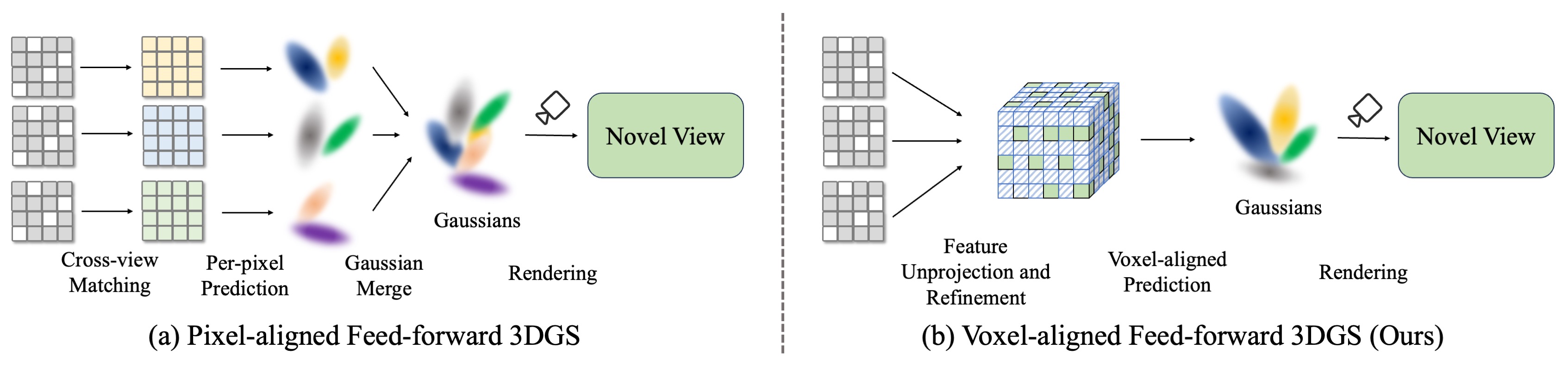
Pixel-aligned feed-forward 3DGS methods suffer from two primary limitations: 1) 2D feature matching struggles to effectively resolve the multi-view alignment problem, and 2) the Gaussian density is constrained and cannot be adaptively controlled according to scene complexity. We propose VolSplat, a method that directly regresses Gaussians from 3D features based on a voxel-aligned prediction strategy. This approach achieves adaptive control over scene complexity and resolves the multi-view alignment challenge.Method
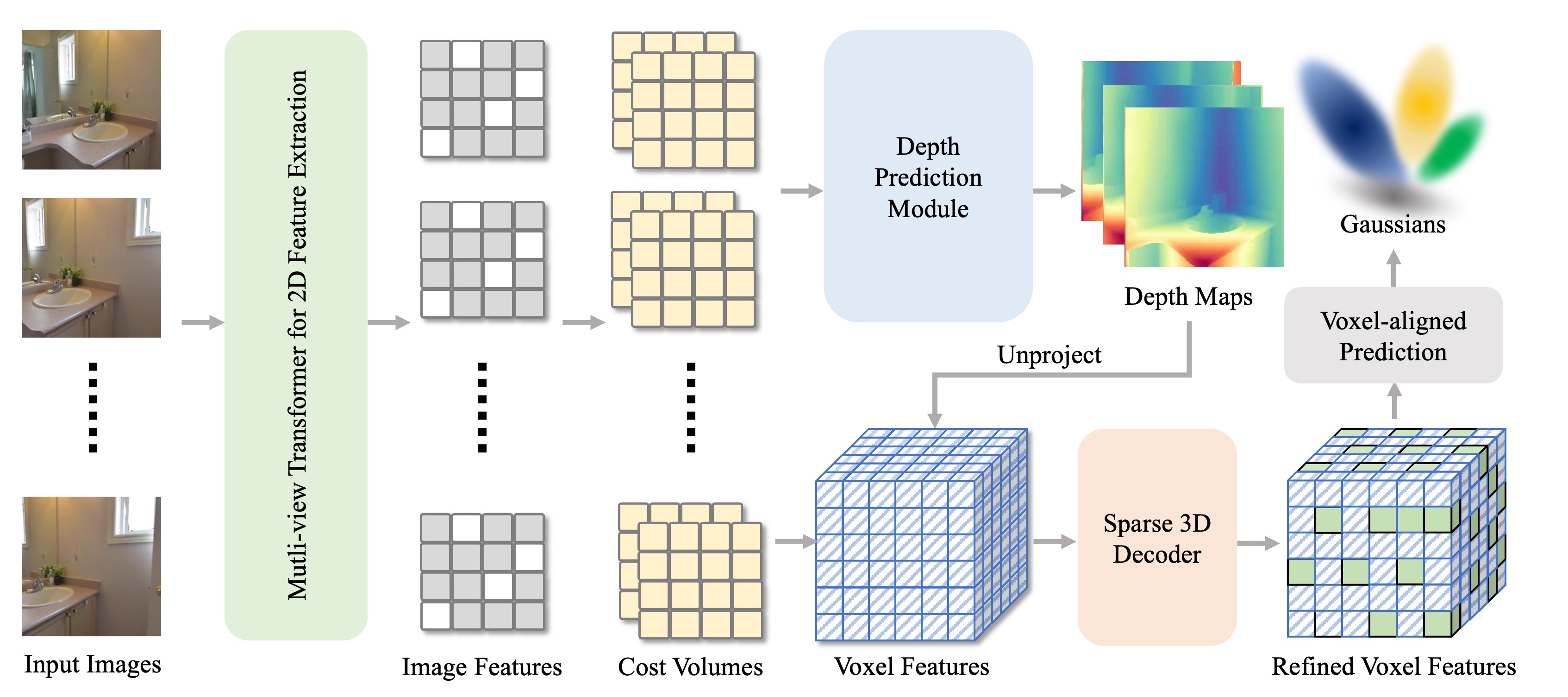
Overview of VolSplat. Given multi-view images as input, we first extract 2D features for each image using a Transformer-based network and construct per-view cost volumes with plane sweeping. Depth Prediction Module then estimates a depth map for each view, which is used to unproject the 2D features into 3D space to form a voxel feature grid. Subsequently, we employ a sparse 3D decoder to refine these features in 3D space and predict the parameters of a 3D Gaussian for each occupied voxel. Finally, novel views are rendered from the predicted 3D Gaussians.TODOs
- Release Code.
- Release Model Checkpoints.
Citation
If you find our work useful for your research, please consider citing us:
@article{wang2025volsplat,
title={VolSplat: Rethinking Feed-Forward 3D Gaussian Splatting with Voxel-Aligned Prediction},
author={Wang, Weijie and Chen, Yeqing and Zhang, Zeyu and Liu, Hengyu and Wang, Haoxiao and Feng, Zhiyuan and Qin, Wenkang and Zhu, Zheng and Chen, Donny Y. and Zhuang, Bohan},
journal={arXiv preprint arXiv:2509.19297},
year={2025}
}
Contact
If you have any questions, please create an issue on this repository or contact at [email protected].
Acknowledgements
This project is developed with DepthSplat. We thank the original authors for their excellent work.